How Your Commercial Roof Impacts HVAC Efficiency
Jump to a section:
Your commercial roof has more control over your monthly energy bill than your thermostat does. On a low-slope building, the roof is the largest surface facing the sun all day, and it sets the heating and cooling load your HVAC system spends money fighting. Strong commercial roof energy efficiency depends on three things working together: a reflective surface, dry and continuous insulation, and rooftop equipment that is not cooking in its own heat. Most owners only think about the first one.
Key takeaways from this guide:
- The roof sets the load: your HVAC system only reacts to the heat your roof lets in.
- Insulation beats reflectivity: a reflective surface helps, but insulation condition usually moves your bill more.
- Wet insulation hides: waterlogged board can lose most of its R-value while looking fine from inside.
- Hot roofs hurt your AC units: rooftop equipment loses efficiency and wears out faster in the heat off a hot roof.
- Air escapes at the weak points: penetrations, curbs, and fasteners quietly drain conditioned air.
- A full re-roof is not always needed: several fixes work on your current roof first.
What actually decides how hard your HVAC has to work?
Your HVAC system does not create your cooling load. It responds to it. Every degree of heat that pushes through your roof in July is heat your air conditioning has to pull back out, and the bigger that incoming load, the longer and harder your equipment runs. The real question for any commercial property is how much work your roof hands the equipment every hour of the day.
Two parts of the roof control that load. The surface decides how much solar heat the roof absorbs versus reflects, and the assembly underneath decides how much of that heat actually reaches the building. A bright, reflective membrane lowers the surface temperature, which is why cool roofs get so much attention. We cover the reflectivity and color side of that decision in our look at the financial benefits of metal roofing for commercial buildings, so we will not repeat it here.
The part that gets far less attention is everything below that surface, and that is where most commercial buildings lose the energy fight. A roof can reflect plenty of sunlight and still bleed money if the insulation is thin, wet, or interrupted. Reflectivity sets the temperature at the top of the roof. Insulation decides how much of that temperature your tenants and your thermostat ever feel. That is the layer we want to look at next.
Is your insulation still working, or is it quietly soaked?
On a commercial roof, insulation does the heavy lifting for energy performance. It is usually a layer of rigid board, often polyiso, installed in a continuous sheet above the deck. Its job is to slow heat transfer in both directions, keeping summer heat out and winter warmth in. When that layer is thick, dry, and unbroken, your HVAC system gets a real break. When it is not, your equipment runs to make up the difference, and you pay for it every month.
The problem we find most often during commercial inspections is insulation that has slowly taken on water. A small roof leak, a failed seam, or standing water that never drains will soak into the boards over time. Wet insulation is a quiet failure because nothing looks wrong from inside the building, the ceiling stays dry, and the roof keeps doing its basic job of keeping rain out. But waterlogged board loses a large share of its insulating value, so a roof that was built to a strong R-value can be performing far below it.
“We have walked commercial roofs where the owner could not understand why their cooling bills kept climbing. The membrane looked fine, but the insulation under it was saturated and had lost most of its R-value. That roof was costing them money long before it ever leaked into the building.” — The team at Skybird Roofing
This is why a roof’s age and warranty paperwork do not tell you its real energy performance. The way to know whether your insulation is dry and intact is to inspect the roof properly, including the areas where water tends to collect. Finding wet insulation early lets you dry or replace a section before it spreads, and it points straight to the next hidden cost: the equipment sitting on top of all of it.
Why does a hot roof punish your rooftop AC units?
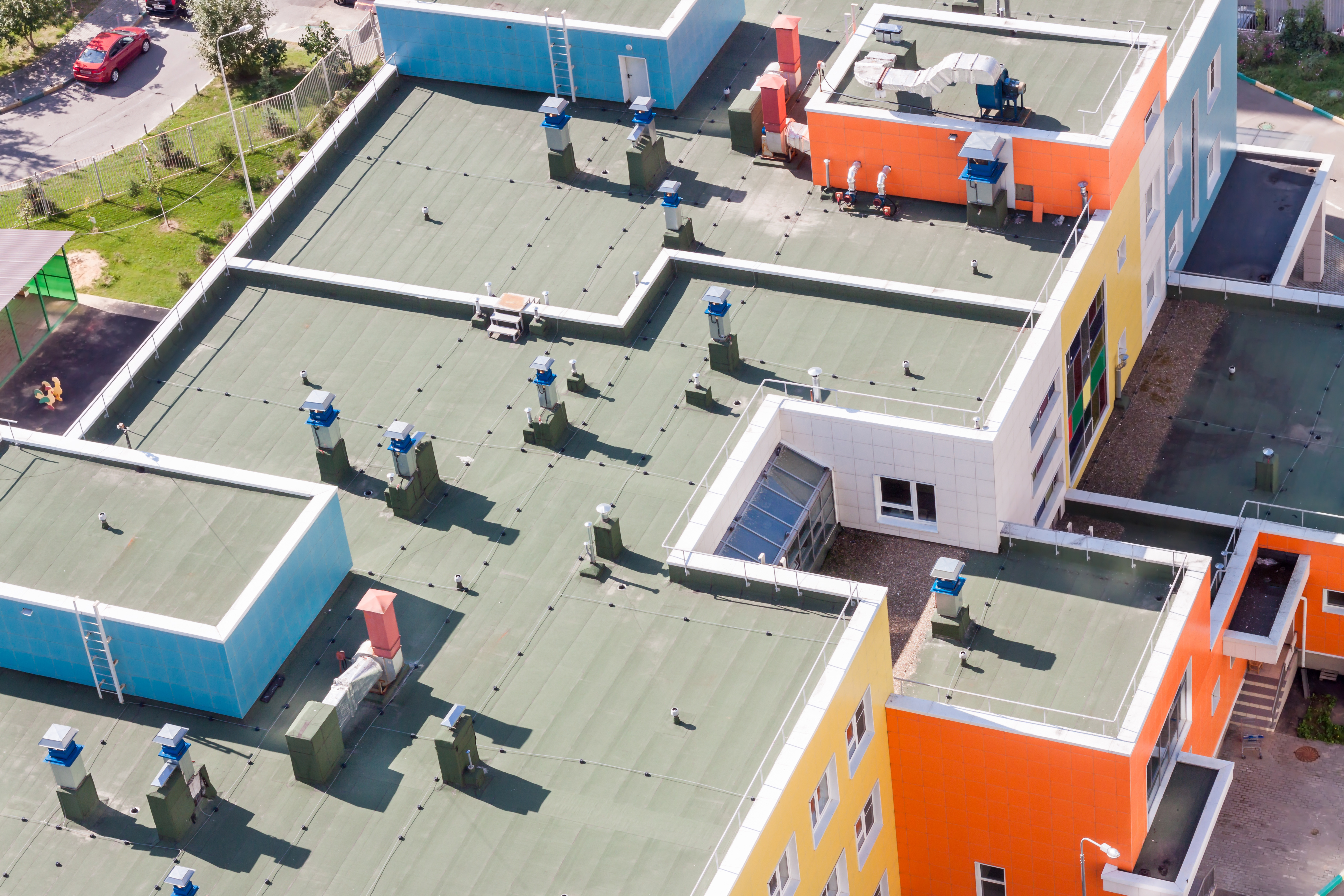
Most commercial buildings carry their air conditioning equipment on the roof. These rooftop units pull in air, reject heat through a condenser, and send cooled air down into the building. They are built to do that well, but only when they can breathe in reasonably cool air. The trouble is that they sit on the one surface that gets hotter than anything else on the property.
On a sunny summer day, a dark, aging membrane can climb past 150 degrees. The air directly above that surface heats up with it, and that is the air your rooftop unit has to breathe. When a condenser tries to dump heat into already-hot air, it cannot reject that heat efficiently, so the unit works harder to deliver the same cooling. You get longer run times, higher power draw, and a system that struggles most on the exact days you need it. The cost shows up on your power bill, but the damage does not stop there. A unit that runs hot and long wears out sooner.
“People treat the roof and the HVAC as two separate systems, but the units live in whatever climate the roof creates. We have seen compressors fail years early simply because they spent every summer pulling in superheated air off a black roof. A cooler roof surface gives that equipment a fighting chance.” — Jacob Vollmer, owner of Skybird Roofing
Lowering the roof’s surface temperature, whether through a reflective membrane or a reflective coating, cools the air around your equipment as well as the building under it. That helps your compressors last and keeps your cooling capacity where it should be. It also raises a fair question every owner eventually asks: where else is conditioned air slipping away?
Where is your conditioned air actually escaping?
A roof can have a cool surface and dry insulation and still leak energy through its weak points. Heat and air do not only move through the open field of membrane. They move through the joints, gaps, and metal parts that interrupt the insulation, and on a commercial roof there are far more of these than most owners expect. Each one is small on its own, but together they form a steady drain on the conditioned air you are paying to produce.
The most common places conditioned air and heat slip through a commercial roof:
- Rooftop unit curbs: The raised frames that hold your HVAC units are a frequent spot for gaps and failed sealant, letting air pass right next to the equipment.
- Penetrations: Pipes, vents, drains, and conduit all break through the roof, and each one is a path for air movement if it is not sealed and flashed correctly.
- Fasteners: Many single-ply roofs are held down with thousands of screws and plates that pass through the insulation. Each metal fastener carries heat straight across the insulation layer, an effect called thermal bridging.
- Parapet walls and edges: The transitions where the roof meets walls and edges are easy to overlook and tend to lose more heat than the open roof field.
None of these show up on your utility bill with a label attached. They simply add to the load your HVAC carries, hour after hour, on top of everything the surface and insulation are already handling. Good detailing closes these paths, which is why workmanship matters just as much as the material you pick. Sealing and re-flashing these areas is routine roof repair work, and on many buildings it returns more energy savings than the owner expected for the cost. That points to the decision most commercial owners are actually trying to make: spend on the roof you have, or replace it.
Should you re-roof for energy, or fix the roof you have?
Here is the honest answer most owners do not hear: you often do not need a full tear-off to lower your energy costs. The right move depends on the condition of your current roof, and a fair assessment should come before any sales pitch. We work with both membrane and metal systems, so we have no reason to push you toward a full replacement when a targeted fix will do the job.
“The most trustworthy thing a roofer can tell a business owner is that they do not need to spend as much as they feared. A coating or a few repairs can buy years of better performance. We would rather earn your trust now than sell you a roof you did not need yet.” — Jacob Vollmer, owner of Skybird Roofing
Steps that improve energy performance on the roof you already have:
- Repair the leaks and seal the penetrations: Stopping water intrusion protects your insulation, and closing gaps cuts air loss right away.
- Dry or replace wet insulation: Removing saturated board and restoring the insulation value brings back performance you have already lost.
- Add a reflective coating: A restorative coating over a sound membrane lowers the surface temperature without the cost of a full re-roof.
- Build up insulation at your next reroof: When replacement does make sense, adding insulation is the single best upgrade for long-term energy savings.
A full replacement earns its cost when the membrane is near the end of its life, the insulation is widely wet, or you want the long-term return that comes with a different roofing system. A good commercial roofing partner will lay out both paths and let the condition of your roof guide the spending, rather than steering you toward the biggest invoice. That kind of straight answer is what we aim to give every property owner who calls us.
How can Skybird Roofing help with your commercial roof?
You cannot tell what your roof is costing you from the parking lot, and the surest way to find out is to have it inspected by people who understand the whole system. At Skybird Roofing, we document commercial roofs with drone and on-site inspections, find the hidden problems that drive up your costs, and give you honest options ranging from targeted repairs to a full replacement. As a GAF Master Elite contractor, a certification fewer than three percent of roofing contractors in the country hold, we install with premium materials and back our work for the long term.
If you want to understand how your commercial roof is affecting your energy costs and HVAC equipment, we can help. Call us at 984-833-1223 or reach out through our contact page to schedule your free commercial roof inspection.